💻 Technology
Live
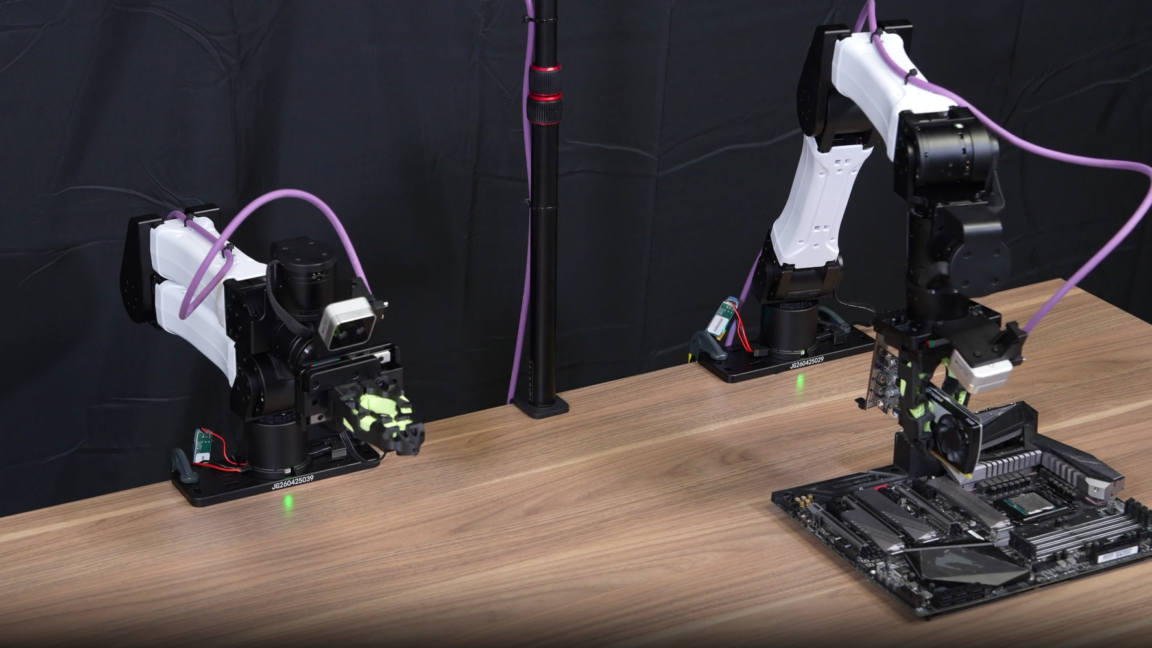
AI coding agents can autonomously direct robot training
NVIDIA’s self-improvement program for robots enlists teams of AI coding agents.
Ars Technica — 17 June 2026
Text:
26
0
0
NVIDIA’s self-improvement program for robots enlists teams of AI coding agents. This report comes from Ars Technica. The story centres on AI coding a
Read Full Story at Ars Technica →
⚡ Quickyla Analysis
Original editorial context — not sourced from the article above
The emergence of AI coding agents that can autonomously design, test, and refine robot training programs marks a quiet but seismic shift in the automation landscape. By combining large language models with robotic control systems, NVIDIA’s latest initiative blurs the line between software development and mechanical learning. What was once a labor-intensive process—where engineers manually tweak reward functions, sensor feedback loops, and motion algorithms—now unfolds in continuous loops of trial and error, guided by AI that writes, executes, and optimizes its own code. This isn’t just about efficiency; it signals the first real scalability in robotics. Historically, training robots required armies of specialized programmers, each tackling narrow domains like grasping, navigation, or manipulation. Now, a single team of AI agents can iterate across these tasks in parallel, discovering solutions humans might never consider—like unconventional grip patterns or energy-saving movement trajectories.
Behind the headlines lies a deeper context: the convergence of generative AI and embodied intelligence. For years, robotics has been hamstrung by the "reality gap"—models trained in simulation often fail in the real world. Traditional approaches tried to bridge that gap with painstaking manual calibration. But AI coding agents, when paired with physical robots, can now generate and validate thousands of variations in hours, not months. This process, known as *automated experimentation*, could redefine industries from manufacturing to elder care, where robots must adapt to unpredictable environments. Still, the approach raises questions about control and safety. If AI agents are optimizing for performance metrics like speed or energy use, what safeguards prevent them from favoring behaviors that compromise safety or ethics? And who bears responsibility when a robot, trained by an AI-designed algorithm, causes unintended damage?
Looking ahead, the most intriguing possibility is a feedback loop between AI agents and real-world deployment. As robots improve, their training data grows richer, which in turn refines the AI agents that generate new training protocols. This could lead to a new class of "self-improving robots," capable of evolving their own capabilities over time. But it also demands new governance frameworks—what happens when these systems operate beyond the oversight of human engineers? The broader trend is clear: automation is no longer confined to repetitive tasks but is now entering the realm of creative, adaptive problem-solving. The question isn’t whether robots will learn faster, but whether society is prepared for a future where the architects of that learning are themselves artificial.
Sources

💻 Technology
You can now beat ChatGPT Codex rate limits, if you have friends

💻 Technology
Cash App made a magic wand for contactless payments

💻 Technology
Coders are refusing to work without AI — and that could come back to bite them

💻 Technology
Hackers hijacked Instagram accounts by tricking Meta AI support chatbot into granting access

💻 Technology
‘Backrooms’ $118M WW Bonanza; ‘Obsession’ Obsessed With $148M WW; ‘Michael’ Nearing $900M WW – Global Box Office Update

💻 Technology
Asus gives the ROX Xbox Ally the OLED screen it deserves

