Lula preserves 20,000 km² of Amazon rainforest since 2022 presidency
Lula’s return to Brazil’s presidency in 2022 coincided with the protection of at least 20,000 km² of Amazon forest – about the size of New Jersey – that would otherwise have been cleared. Satellite d…
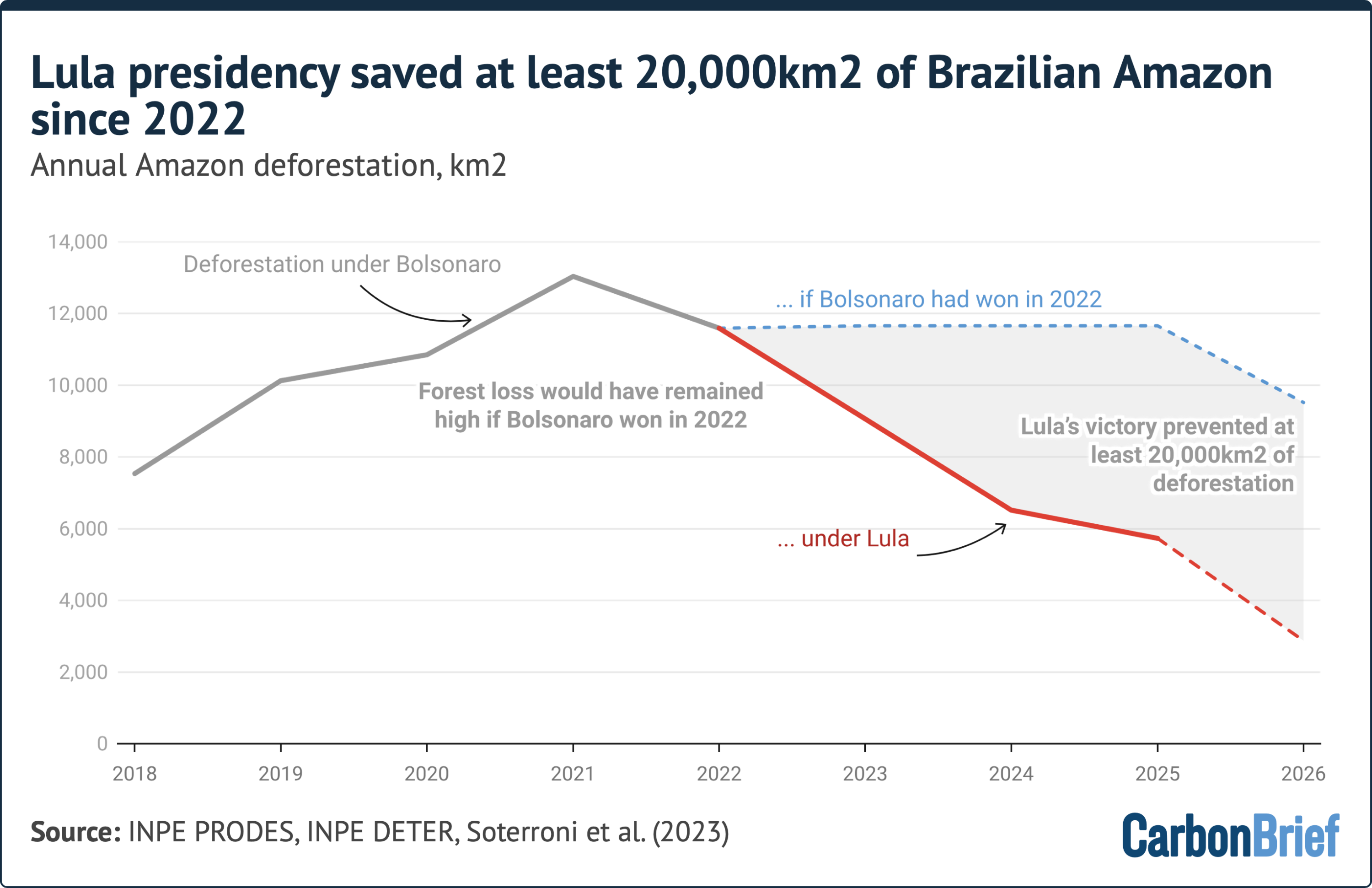
Lula’s return to Brazil’s presidency in 2022 coincided with the protection of at least 20,000 km² of Amazon forest – about the size of New Jersey – that would otherwise have been cleared. Satellite data released by Carbon Brief show that this area has remained standing since the beginning of Lula’s term, a stark contrast to the sharp rise in deforestation under his predecessor. The protection covers a portion of the western Amazon, a region that had seen some of the highest rates of forest loss in recent years.
The Amazon is a critical global resource. It stores roughly 20 % of the world’s terrestrial carbon and hosts an estimated 10 % of global biodiversity. Loss of forest area speeds climate change, reduces rainfall, and threatens wildlife. In 2020, Brazil logged over 10 000 km² of new deforestation, the highest level in a decade. By 2022, that figure had dropped to under 3 000 km², a 70 % reduction that the new administration attributes to stronger enforcement and policy changes.
Lula’s administration has increased funding for environmental agencies, expanded satellite monitoring, and tightened penalties for illegal logging. The National Institute for Space Research (INPE) now has a larger budget for real‑time forest surveillance, while the Brazilian Institute of Environment and Renewable Natural Resources (IBAMA) has more inspectors on the ground. These measures were supported by a broader political shift that moved the government away from the agribusiness‑friendly policies of the previous administration, which had loosened environmental protections to boost soybean and cattle production.
Looking ahead, the gains could be fragile. Brazil’s next presidential election will bring new pressure from agribusiness interests, and economic downturns could lead to cuts in environmental budgets. International climate talks are putting Brazil’s Amazon under scrutiny, and the country has pledged to reduce deforestation to zero by 2030. If the current enforcement gains are reversed, the global community could lose a vital carbon sink, worsening climate change. The next few years will test whether Brazil can keep protecting the Amazon while balancing economic growth.
Read Full Story at Carbon Brief →