🌍 World News
Live
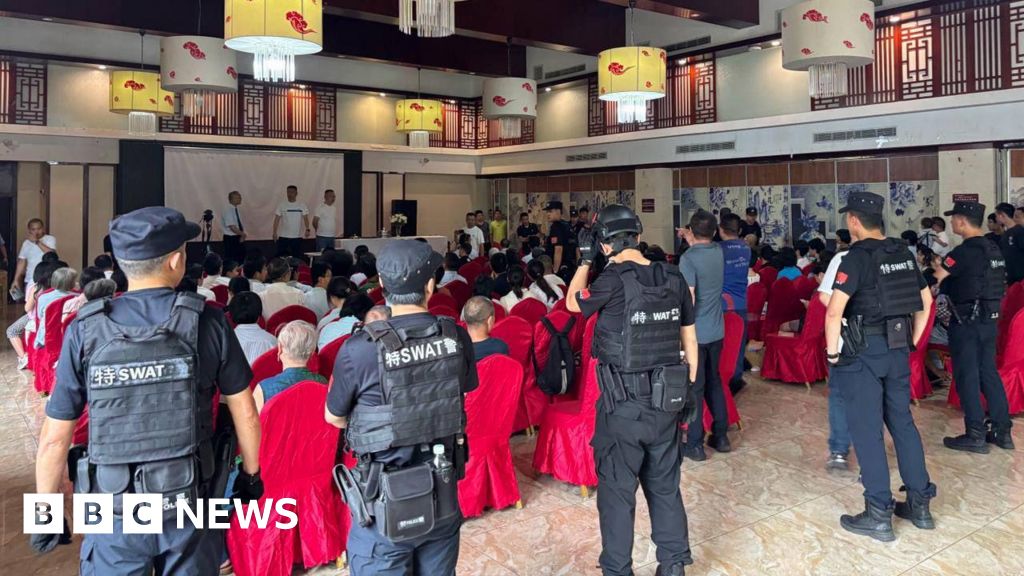
China detains two leaders of influential underground church
An influential Protestant church in China has said two of its leaders were detained after more than dozens of congregants, including children, were rounded up for interrogation. They were midway thr…
BBC World News — 15 June 2026
Text:
37
0
0
An influential Protestant church in China has said two of its leaders were detained after more than dozens of congregants, including children, were ro
Read Full Story at BBC World News →
⚡ Quickyla Analysis
Original editorial context — not sourced from the article above
The detention of two leaders from an influential underground Protestant church in China marks another escalation in the government’s crackdown on unregistered religious groups, raising critical questions about the state’s evolving approach to faith and dissent. While state media often frames these measures as necessary to combat extremism and maintain social order, the broader significance lies in how such actions reflect deeper tensions between Beijing’s push for ideological control and the enduring resilience of grassroots religious communities. Underground churches—those not affiliated with the state-sanctioned Three-Self Patriotic Movement—have long operated in legal gray areas, but recent detentions suggest a renewed determination to suppress independent expressions of faith that fall outside official frameworks.
This crackdown comes amid a broader tightening of religious freedoms in China, where policies once framed as modernization under Xi Jinping have increasingly prioritized conformity over pluralism. The targeting of church leaders, particularly in high-profile cases, serves as a warning to other unregistered congregations, signaling that even well-established communities are not immune to state interference. The inclusion of children in previous interrogations underscores the government’s willingness to weaponize psychological pressure, a tactic that not only disrupts religious practices but also sends a chilling message to families seeking alternative spiritual spaces.
What remains uncertain is whether these detentions represent an isolated crackdown or the start of a more systematic purge. The church’s prominence could make it a test case for how far authorities are willing to go to enforce compliance, with potential ripple effects across other unregistered groups. Observers will closely watch for signs of escalation—such as forced closures, property seizures, or legal proceedings—as indicators of the state’s long-term strategy.
The story also intersects with broader global trends, where authoritarian governments increasingly view religion as a potential threat to political stability. China’s approach contrasts sharply with its historical use of religion as a tool for social control, revealing a paradox where even non-political faith communities face suppression. For the families and congregants caught in this crackdown, the immediate concern is survival; for the rest of the world, it’s a reminder that in Xi’s China, devotion outside state parameters comes at a steep price.
Sources

🌍 World News
Agitators outside Delaney Hall set up organized logistics operation before Newark protests began

🌍 World News
Man fleeing police attacked by alligator before continuing his getaway, Louisiana authorities say
🌍 World News
US crude exports hit record high in May as Iran war tightens global oil supplies

🌍 World News
French doctors sound alarm over drinking water pollution

🌍 World News
Iran, Kuwait, Bahrain hit: Is the war in the Gulf escalating again?

🌍 World News
Four people trapped in flooded cave in Laos pulled to safety


