🔬 Science
Live
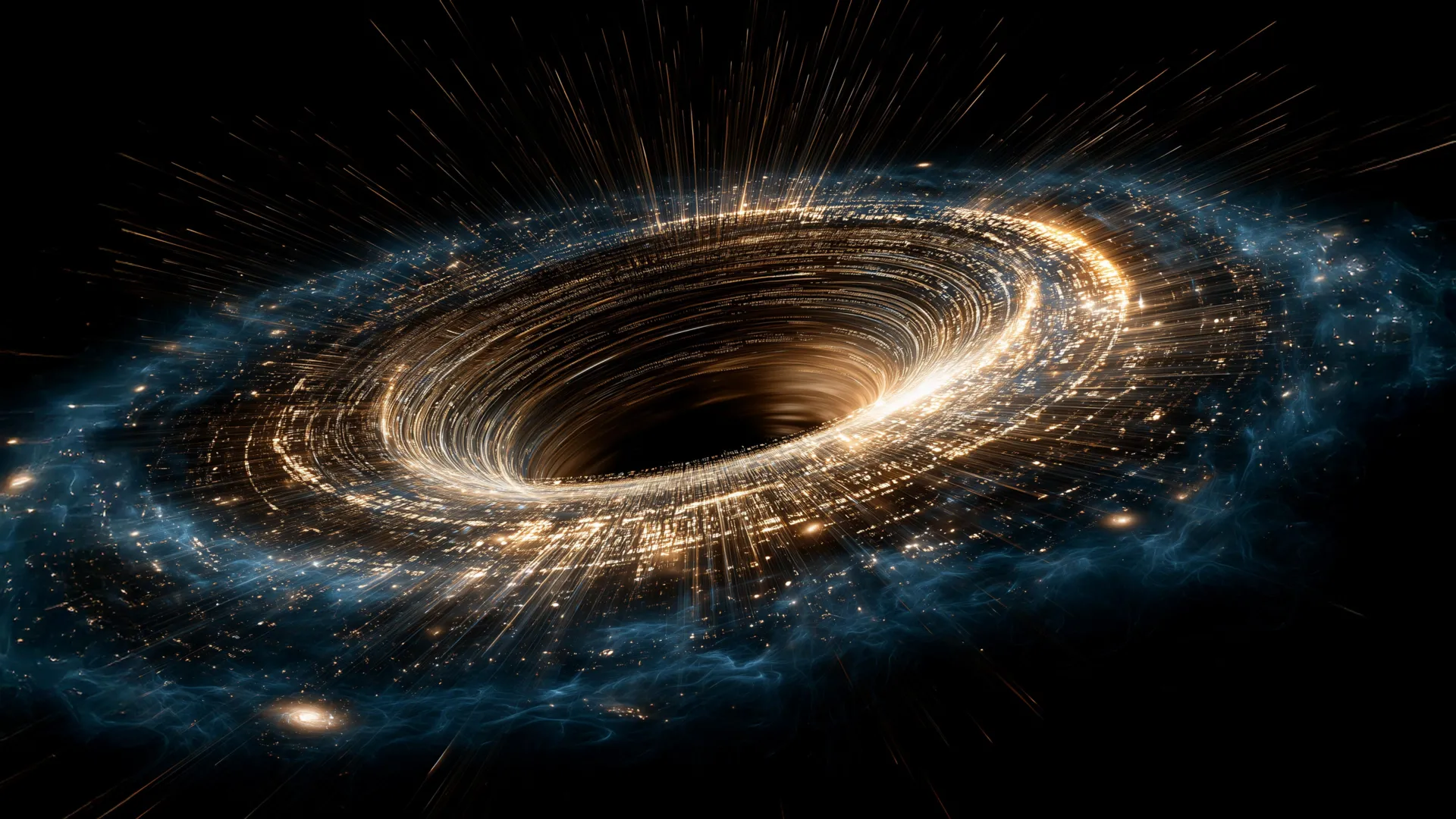
Could cosmic memory explain dark matter, dark energy, and black holes?
A new theory suggests the universe is constantly recording its own history in the fabric of spacetime. If correct, this cosmic memory could help solve some of the biggest puzzles in physics, from bla…
ScienceDaily — 18 June 2026
Text:
24
0
0
A new theory suggests the universe is constantly recording its own history in the fabric of spacetime. If correct, this cosmic memory could help solve
Read Full Story at ScienceDaily →
⚡ Quickyla Analysis
Original editorial context — not sourced from the article above
The idea that the universe might be its own historian—preserving a record of itself in the very fabric of spacetime—isn’t just poetic; it’s a radical departure from how modern physics has long framed cosmic evolution. If this theory, which suggests that spacetime itself acts as a kind of memory storage, holds any truth, it could upend our understanding of dark matter, dark energy, and even the nature of black holes. These remain among the most elusive phenomena in astrophysics, and their stubborn resistance to explanation has left scientists searching for frameworks beyond the Standard Model and general relativity. A cosmic memory mechanism could provide a unifying principle, suggesting that these enigmas aren’t separate anomalies but interconnected artifacts of a universe that has been continuously logging its own history since the Big Bang.
The theoretical roots of this idea stretch back to quantum information theory and holographic principles, which propose that information—rather than matter or energy—may be the fundamental currency of reality. In this view, black holes aren’t just gravitational sinks but cosmic hard drives, preserving the quantum states of everything that ever fell into them. Meanwhile, dark energy, the mysterious force accelerating the universe’s expansion, might not be a separate entity but a residual effect of spacetime “replaying” its own past states. This challenges the conventional separation of matter, energy, and information, implying that the universe operates more like a self-documenting system than a static stage for physical processes.
Yet the biggest open question is whether such a mechanism can be empirically verified. If spacetime does store information, how would we detect it? Proposed tests might involve looking for subtle imprints in gravitational waves or analyzing the distribution of dark matter for patterns that suggest a self-referential origin. But even if the theory remains untestable for now, it forces a reckoning with how we conceptualize time and causality. If the universe is constantly writing its own history, does that mean the past is still being edited? And could this perspective finally bridge the divide between quantum mechanics and gravity, two theories that have resisted reconciliation for a century?
What makes this theory particularly compelling is its timing. As particle physics grapples with the failure of the Large Hadron Collider to find new particles beyond the Higgs boson, and as dark matter searches come up empty-handed after decades of effort, radical new ideas are not just welcome—they’re necessary. Whether this specific theory survives scrutiny or not, the push toward information-centric cosmology signals a deeper shift in how we interrogate the universe’s deepest mysteries.
Sources

🔬 Science
'Astonishing': James Webb telescope spots the most chemically primitive galaxy in the ancient universe

🔬 Science
El Niño Is Underway

🔬 Science
Astronomers gaze into the 'Crystal Ball Nebula' and see a vision of our dying sun — Space photo of the week

🔬 Science
NASA Awards Contract for Johnson Space Center Infrastructure

🔬 Science
Bacteria uncover distinct strategy to import rare sugar polymers, crystal structures show

🔬 Science
Repairing DNA damage: Scientists discover a surprising new benefit of melatonin

