'Crystals' of space-time could be the origins of certain rare black holes, theoretical study hints
By taking general relativity into higher dimensions, a trio of physicists has proven that a mathematical pattern of ripples in space-time geometry could give rise to naked singularities and microscop…
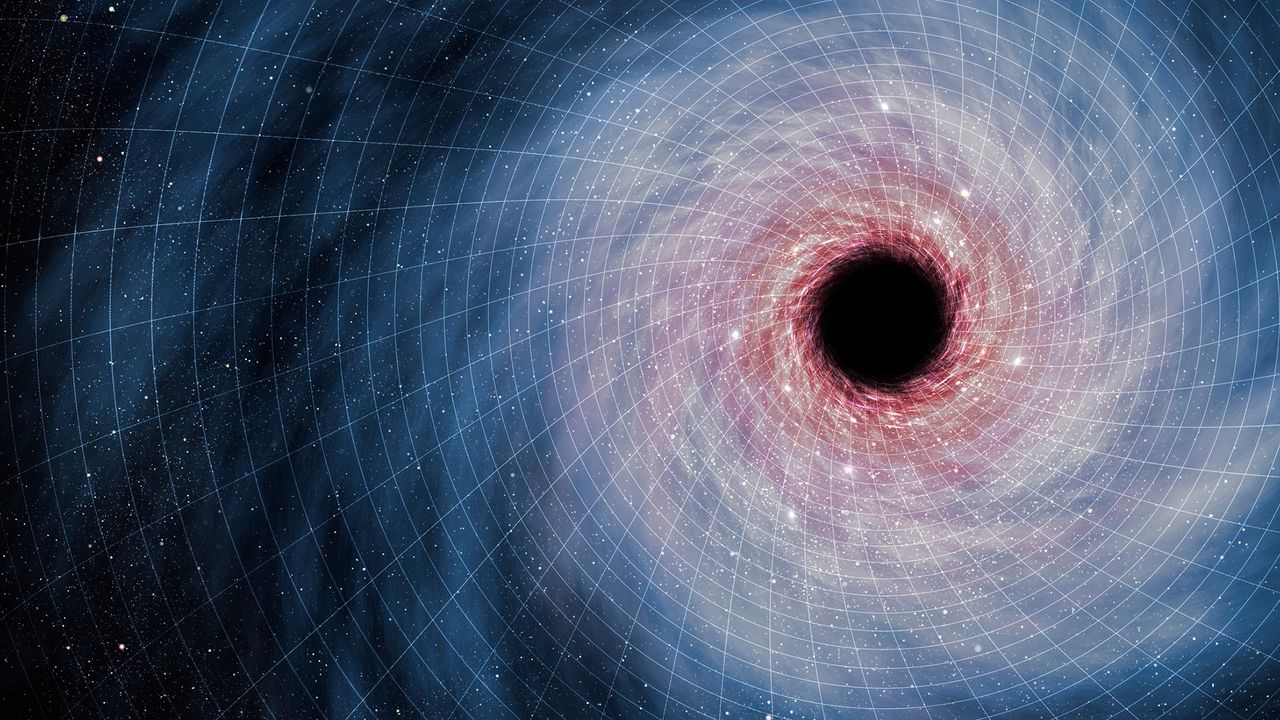
By taking general relativity into higher dimensions, a trio of physicists has proven that a mathematical pattern of ripples in space-time geometry cou
Read Full Story at Live Science →Why This Matters
The discovery suggests that some of the universe’s most enigmatic objects—black holes with no event horizons—might not stem from stellar collapse or cosmic mergers, but from fundamental distortions in the fabric of reality itself. If "crystals" of space-time can indeed produce naked singularities, it challenges our understanding of causality, potentially rewriting the rules of general relativity in regimes where quantum effects dominate. This could bridge the gap between Einstein’s classical framework and the still-elusive theory of quantum gravity.
Background Context
General relativity has long assumed four dimensions—three of space and one of time—but higher-dimensional physics, inspired by string theory and brane cosmology, has gained traction in recent decades. Naked singularities, where space-time breaks down without a horizon to hide it, were dismissed as unphysical by Roger Penrose’s cosmic censorship conjecture, yet they’ve resurfaced in theoretical models where extra dimensions warp geometry unpredictably. The study builds on this legacy, probing whether such singularities could be stable or even inevitable under certain conditions.
What Happens Next
If further simulations or observations confirm these space-time "crystals" as viable progenitors of naked singularities, astrophysicists may need to revisit how they classify black holes and their observational signatures. The next generation of gravitational wave detectors, like LISA, could hunt for anomalous signals that might betray their existence. Meanwhile, theorists will likely explore whether these structures could leave imprints in cosmic microwave background data or even influence dark matter distributions.
Bigger Picture
This research aligns with a broader push to test general relativity in extreme regimes, from black hole mergers to the early universe’s inflationary epoch. It also reflects a growing fascination with higher-dimensional physics, which could explain dark matter or even offer a framework for quantum gravity. As computational power advances, such thought experiments may transition from mathematical curiosities to testable hypotheses, reshaping our cosmic narrative.







