Google AI Edge Gallery launches on macOS, letting Mac users run Gemini models locally
In addition to Google AI Edge Gallery, which lets users run Gemma models locally on their Macs, the company also released the Gemma 4 12B model and the Google AI Edge Eloquent dictation app for the M…
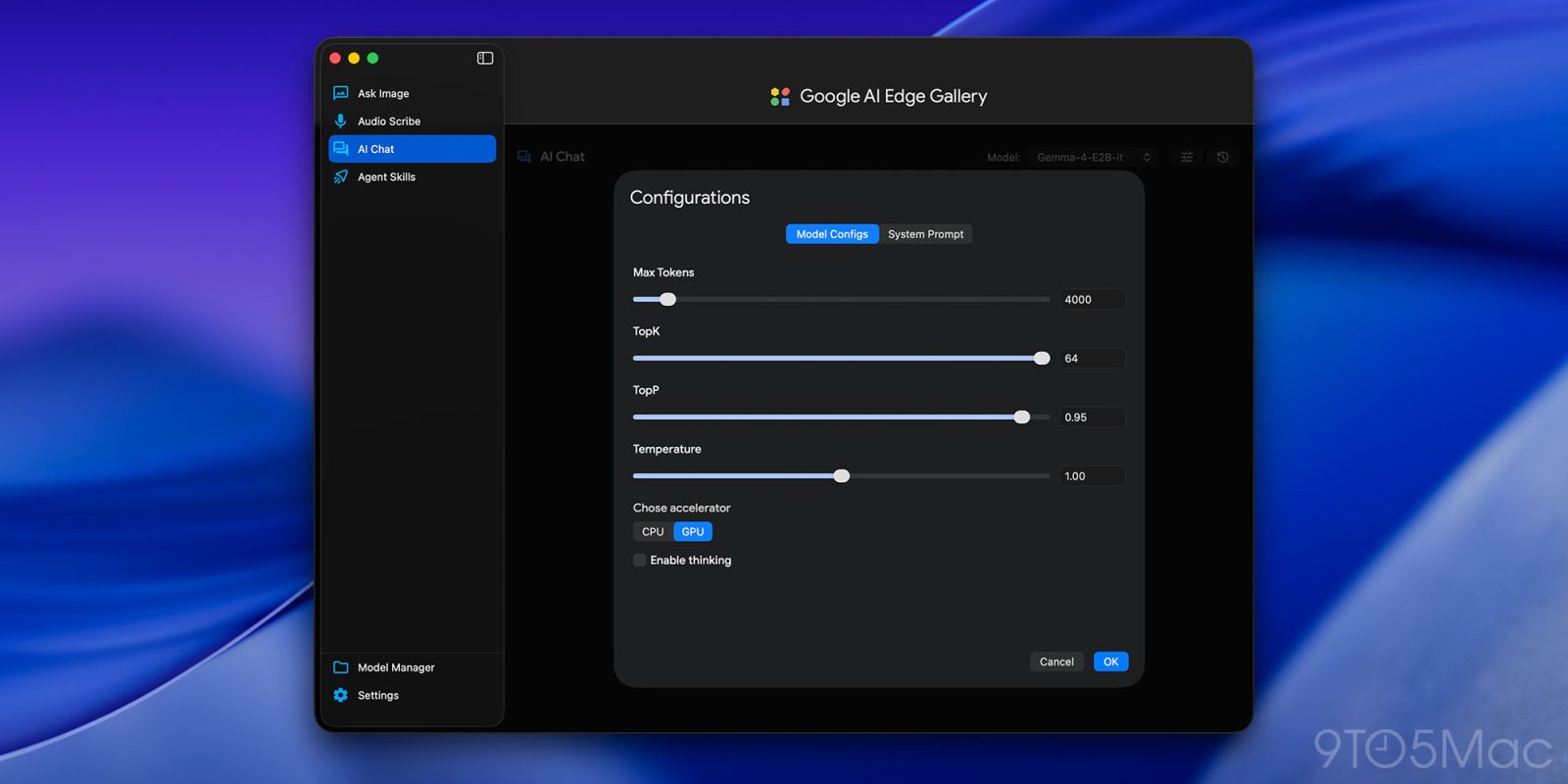
In addition to Google AI Edge Gallery, which lets users run Gemma models locally on their Macs, the company also released the Gemma 4 12B model and th
Read Full Story at 9to5Mac →Why This Matters
The launch of Google's AI Edge Gallery for macOS represents a strategic pivot toward decentralizing AI capabilities, challenging the dominance of cloud-based models by enabling local execution. This move could democratize access to cutting-edge AI tools for developers and researchers, particularly those in regions with restrictive data policies or limited cloud infrastructure. For Mac users, it signals a shift toward more private, offline AI experiences without sacrificing performance.
Background Context
Google's Gemma models have emerged in a crowded field where open-source alternatives like Meta's Llama and Mistral's Mixtral compete for developer adoption. The company's decision to prioritize macOS—despite Apple's closed ecosystem—highlights a calculated bet on the platform's growing appeal among AI researchers, who often favor Unix-based systems for their flexibility. Meanwhile, the release of the Gemma 4 12B model suggests Google is iterating rapidly to close the performance gap with larger proprietary models.
What Happens Next
Developers will likely test the limits of local execution, particularly around inference speed and hardware optimization for Apple Silicon. The success of the Eloquent dictation app may hinge on its integration with macOS's native speech recognition, raising questions about whether Google can offer a superior alternative to Siri's ecosystem. Watch for third-party integration—such as plugins for Xcode or Terminal tools—to gauge adoption beyond early adopters.
Bigger Picture
This aligns with a broader trend of "edge AI," where models run on-device to reduce latency and improve privacy. Apple's own M-series chips are uniquely positioned to benefit from this shift, and Google's move suggests a recognition that local AI is no longer a niche use case but a core battleground. The competition here isn't just about model performance—it's about control over the data pipeline and the user experience.




