🌍 World News
Live
How Germany and Poland rebooted relations 35 years ago
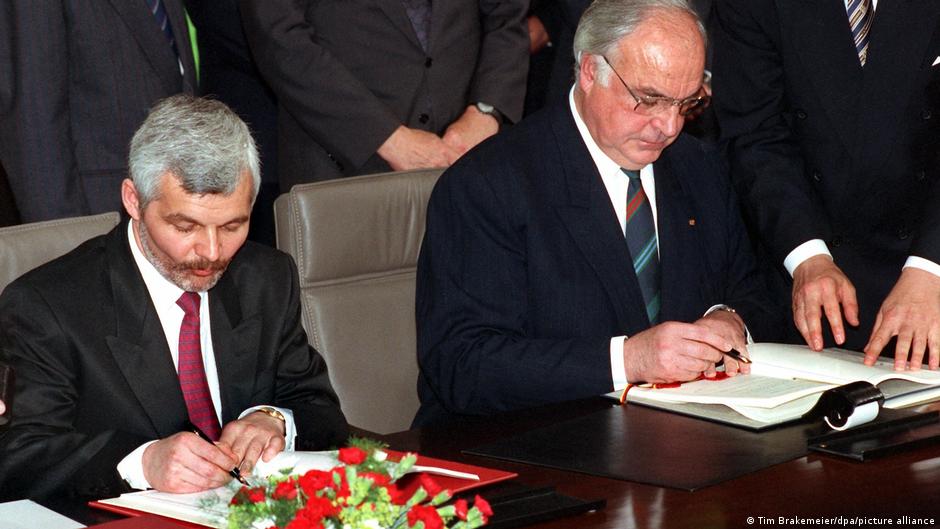
On June 17, 1991, Polish Prime Minister Jan Krzysztof Bielecki and German Chancellor Helmut Kohl met in Bonn — then the seat of the German government — to sign the Treaty between the Federal Republic…
DW World — 16 June 2026
Text:
18
0
0
On June 17, 1991, Polish Prime Minister Jan Krzysztof Bielecki and German Chancellor Helmut Kohl met in Bonn — then the seat of the German government
Read Full Story at DW World →
⚡ Quickyla Analysis
Original editorial context — not sourced from the article above
The June 17, 1991, meeting between Polish Prime Minister Jan Krzysztof Bielecki and German Chancellor Helmut Kohl in Bonn was more than a diplomatic milestone—it marked the symbolic end of a centuries-long cycle of distrust and conflict, and the tentative beginning of a new era in Central Europe. At the heart of this breakthrough was the Treaty on Good Neighborliness and Friendly Cooperation, which laid the legal groundwork for reconciliation after the devastation of World War II and decades of Cold War division. While the broader European integration process, including Poland’s eventual EU accession in 2004, often overshadows this moment, the 1991 treaty was a critical step in healing historical wounds that had long shaped bilateral relations. It signaled that Germany, now reunified and anchored in the West, was ready to confront its past not through silence or reparation payments alone, but through sustained partnership with a newly democratic Poland.
Yet the significance of the Bonn meeting extends beyond symbolism. It occurred at a pivotal juncture in European history—the collapse of the Soviet Union and the re-emergence of independent states in Central and Eastern Europe. Poland, having shed communist rule just two years earlier, faced a daunting task: integrating with a unified Germany while navigating its geopolitical vulnerability. The treaty provided a framework for economic cooperation, border security, and minority rights, addressing German minority communities in Poland and Polish workers in Germany. It also set a precedent for how former adversaries could transition from confrontation to cooperation within a broader Euro-Atlantic context.
Looking ahead, the long-term implications of this reconciliation continue to unfold. Poland’s subsequent pivot toward NATO and the EU, Germany’s role as a key investor in Poland’s post-communist transition, and even the periodic strains over rule-of-law issues or energy dependence all trace back to the trust built in 1991. Today, as Europe confronts new divisions—be it over migration, defense, or relations with Russia—the durability of this partnership remains a test of regional stability. The open question is whether this model of reconciliation can inspire similar efforts elsewhere, or whether rising nationalism and historical grievances will erode the foundations laid three decades ago.
Sources

🌍 World News
Man fleeing police attacked by alligator before continuing his getaway, Louisiana authorities say
🌍 World News
US crude exports hit record high in May as Iran war tightens global oil supplies

🌍 World News
Agitators outside Delaney Hall set up organized logistics operation before Newark protests began

🌍 World News
French doctors sound alarm over drinking water pollution

🌍 World News
Iran, Kuwait, Bahrain hit: Is the war in the Gulf escalating again?

🌍 World News
Four people trapped in flooded cave in Laos pulled to safety

