Keir Starmer - then and now
A look back at Kier Starmer's first speech outside number 10 in 2024, compared to his resignation speech today.
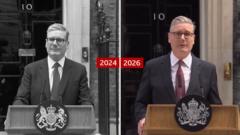
A look back at Kier Starmer's first speech outside number 10 in 2024, compared to his resignation speech today. This report comes from BBC Politics.
Read Full Story at BBC Politics →Why This Matters
The contrast between Keir Starmer's two speeches at 10 Downing Street—one marking his ascension to power and the other his abrupt departure—reveals more than just personal political fortunes. It underscores the volatility of modern British politics, where electoral mandates can evaporate as swiftly as they are secured, leaving institutions to grapple with the legacy of unmet expectations.
Background Context
Starmer's tenure began amid Labour’s landslide victory in July 2024, a mandate built on promises of stability and reform following years of Conservative turmoil. Yet his resignation today follows a cascade of crises—from economic stagnation to institutional distrust—that have reshaped voter perceptions faster than any opposition could. The absence of a clear successor or cohesive Labour strategy raises questions about whether the party’s victory was ever more than a fleeting reaction to Tory decline.
What Happens Next
The immediate focus will be on Labour’s leadership contest, where internal divisions could deepen if factions prioritize ideological purity over electoral pragmatism. Meanwhile, the Conservatives—despite their own disarray—may find renewed energy in portraying Labour as a party unable to govern beyond its initial momentum. The biggest wildcard remains whether Starmer’s resignation triggers a broader realignment, or if the public’s appetite for change has simply been exhausted.
Bigger Picture
Starmer’s rapid fall from grace reflects a broader erosion of trust in political leadership across Western democracies, where voters oscillate between hope and disillusionment at unprecedented speed. It also highlights the unforgiving arithmetic of modern governance: even a historic mandate can crumble under the weight of unaddressed systemic pressures, from public services to geopolitical volatility. The question now is whether Labour’s next leader can navigate this landscape—or if Britain is entering an era of perpetual political turnover.








