James Webb finds millions of stars in Cigar Galaxy
The James Webb Space Telescope revealed millions of stars in the Cigar Galaxy (M82), 12 million light years away, using infrared sensors to see through dust. This helps scientists understand how stars
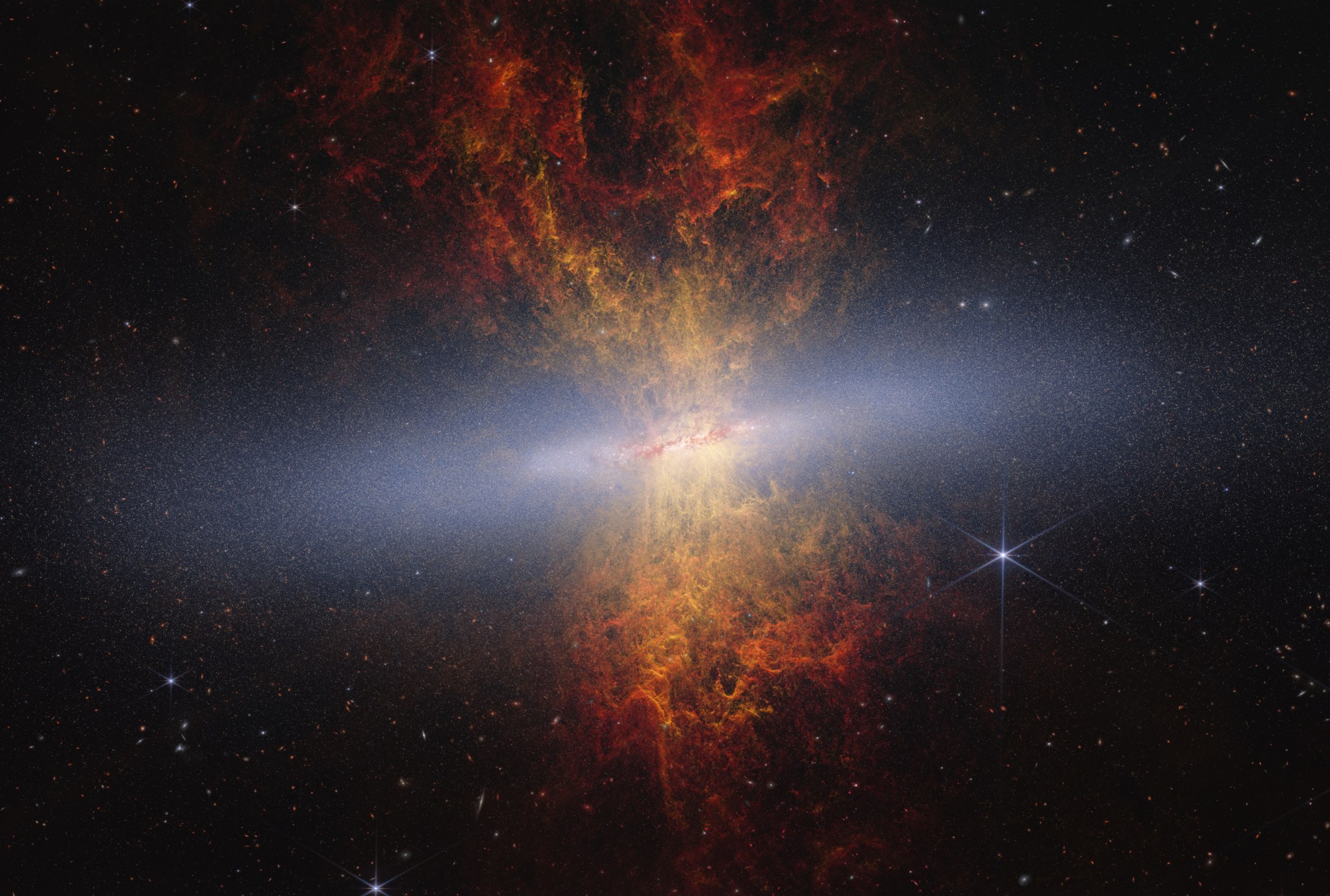
The James Webb Space Telescope just captured a dazzling new view of the Cigar Galaxy, revealing millions of stars packed into a galaxy 12 million ligh
Read Full Story at NASA →Why This Matters
The discovery underscores the James Webb Space Telescope's unparalleled ability to pierce cosmic dust and reveal the hidden mechanics of star formation in extreme environments. By mapping millions of stars in M82, astronomers edge closer to solving one of astrophysics' oldest puzzles: how galaxies like ours or others evolve under intense radiation and stellar winds.
Background Context
M82, also known as the Cigar Galaxy, has long been a laboratory for extreme astrophysics due to its violent starburst activity—where stars are born at rates hundreds of times faster than in the Milky Way. Decades of ground-based and space telescope observations hinted at its dense stellar population, but infrared breakthroughs have now provided an unprecedented census of its stellar population.
What Happens Next
Further infrared surveys of M82 and similar galaxies will likely refine models of star formation under extreme conditions, potentially challenging or confirming existing theories. Researchers may also prioritize follow-up observations to detect rare or transient events, such as supernovae, that could offer additional clues about stellar lifecycles in such environments.
Bigger Picture
This discovery aligns with a broader renaissance in infrared astronomy, where new telescopes are unlocking previously invisible aspects of the universe. It also highlights how studying galaxies like M82—often akin to cosmic time capsules—helps scientists piece together the history of star formation across the cosmos, from the early universe to the present day.






