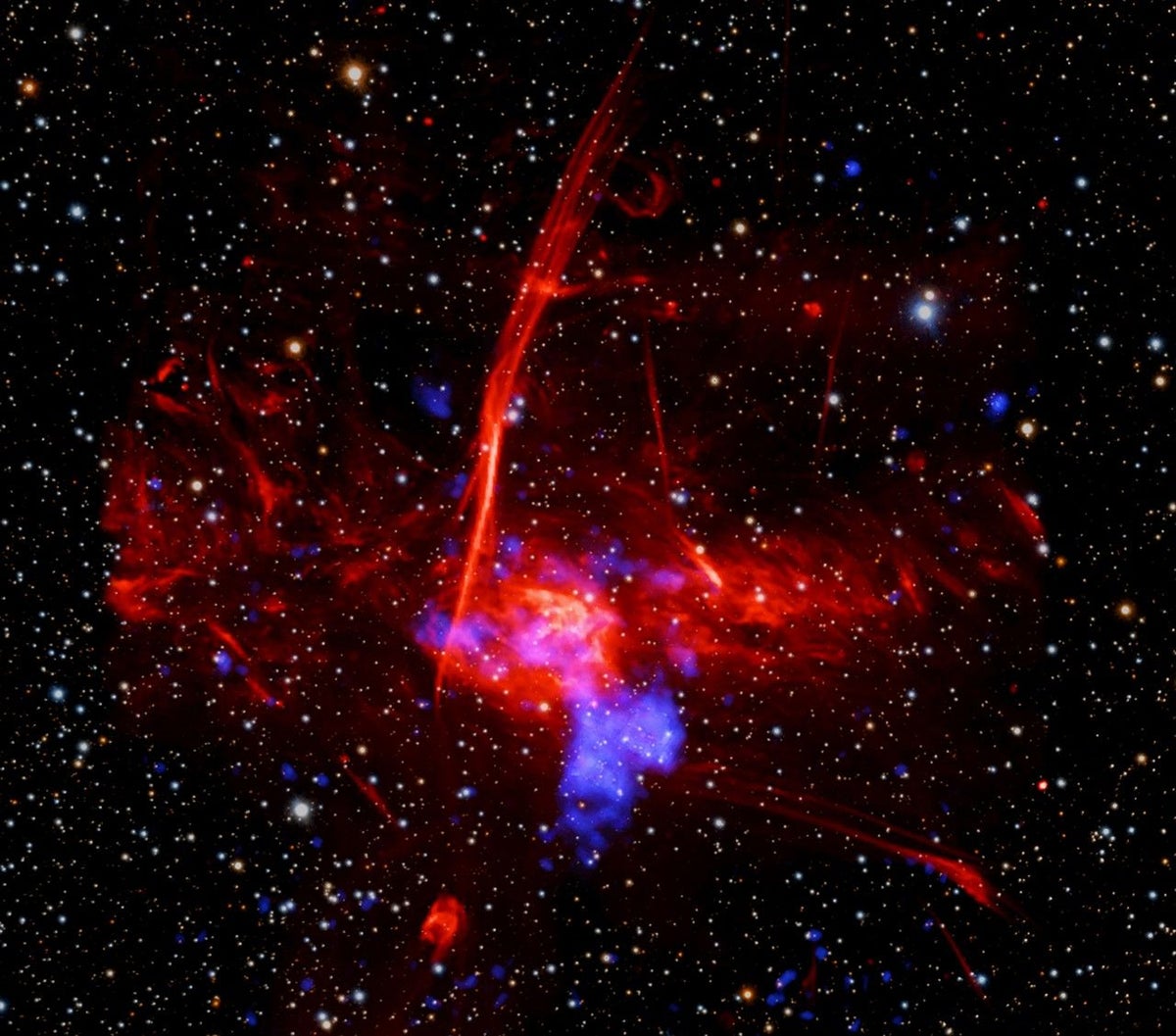
NASA’s Chandra Observatory spots possible supernova remnant in the middle of our galaxy
NASA spots the possible remains of a massive supernova in the middle of the Milky Way If the supernova remnant is confirmed, it would be one of the closest to the supermassive black hole that lies i…
Scientific American — 15 June 2026
Text:
20
0
0
NASA spots the possible remains of a massive supernova in the middle of the Milky Way If the supernova remnant is confirmed, it would be one of the c
Read Full Story at Scientific American →
⚡ Quickyla Analysis
Original editorial context — not sourced from the article above
The discovery by NASA’s Chandra X-ray Observatory of what may be a supernova remnant near the heart of the Milky Way underscores the dynamic and often violent nature of our galaxy’s central region. While supernovae are not uncommon in the cosmos, their remnants near the supermassive black hole Sagittarius A* (Sgr A*) are particularly significant. This potential find could reshape our understanding of how stellar explosions interact with the extreme environment surrounding galactic cores, where gravitational forces and magnetic fields play a dominant role. If confirmed, this remnant would be among the closest to Sgr A*, offering a rare opportunity to study how such cosmic cataclysms influence the evolution of supermassive black holes and the interstellar medium in their vicinity.
The galactic center is a densely packed region, teeming with massive stars, dense molecular clouds, and intense radiation—all of which can obscure or distort observations. Supernova remnants in this area are often difficult to distinguish from other high-energy phenomena, such as outbursts from Sgr A* itself or the winds of nearby Wolf-Rayet stars. Historically, only a handful of confirmed supernova remnants have been identified within a few hundred light-years of the black hole, making this potential discovery all the more intriguing. Past surveys, including those by Chandra and other telescopes like the Very Large Array, have struggled to separate these remnants from the background noise, highlighting the challenges of observing in such a crowded and energetic environment.
Should further observations confirm this remnant, astronomers will likely focus on its composition, age, and the mechanisms by which it has survived—or been altered by—the black hole’s gravitational influence. The data could also provide clues about the rate of supernovae in the galactic center, a topic still debated due to observational limitations. Additionally, the discovery might prompt a reevaluation of how these remnants contribute to the heating and chemical enrichment of the interstellar medium, processes that are critical to star formation and the lifecycle of galaxies. As next-generation telescopes like the James Webb Space Telescope or the upcoming Nancy Grace Roman Space Telescope come online, the ability to resolve such distant and obscured remnants will only improve, potentially unlocking deeper insights into the Milky Way’s most turbulent regions.
Sources

🔬 Science
'Astonishing': James Webb telescope spots the most chemically primitive galaxy in the ancient universe

🔬 Science
El Niño Is Underway

🔬 Science
Astronomers gaze into the 'Crystal Ball Nebula' and see a vision of our dying sun — Space photo of the week

🔬 Science
Bacteria uncover distinct strategy to import rare sugar polymers, crystal structures show

🔬 Science
NASA Awards Contract for Johnson Space Center Infrastructure

🔬 Science
Repairing DNA damage: Scientists discover a surprising new benefit of melatonin

