NASA’s Fermi Mission Uncovers Possible Sibling Supernova Remnants
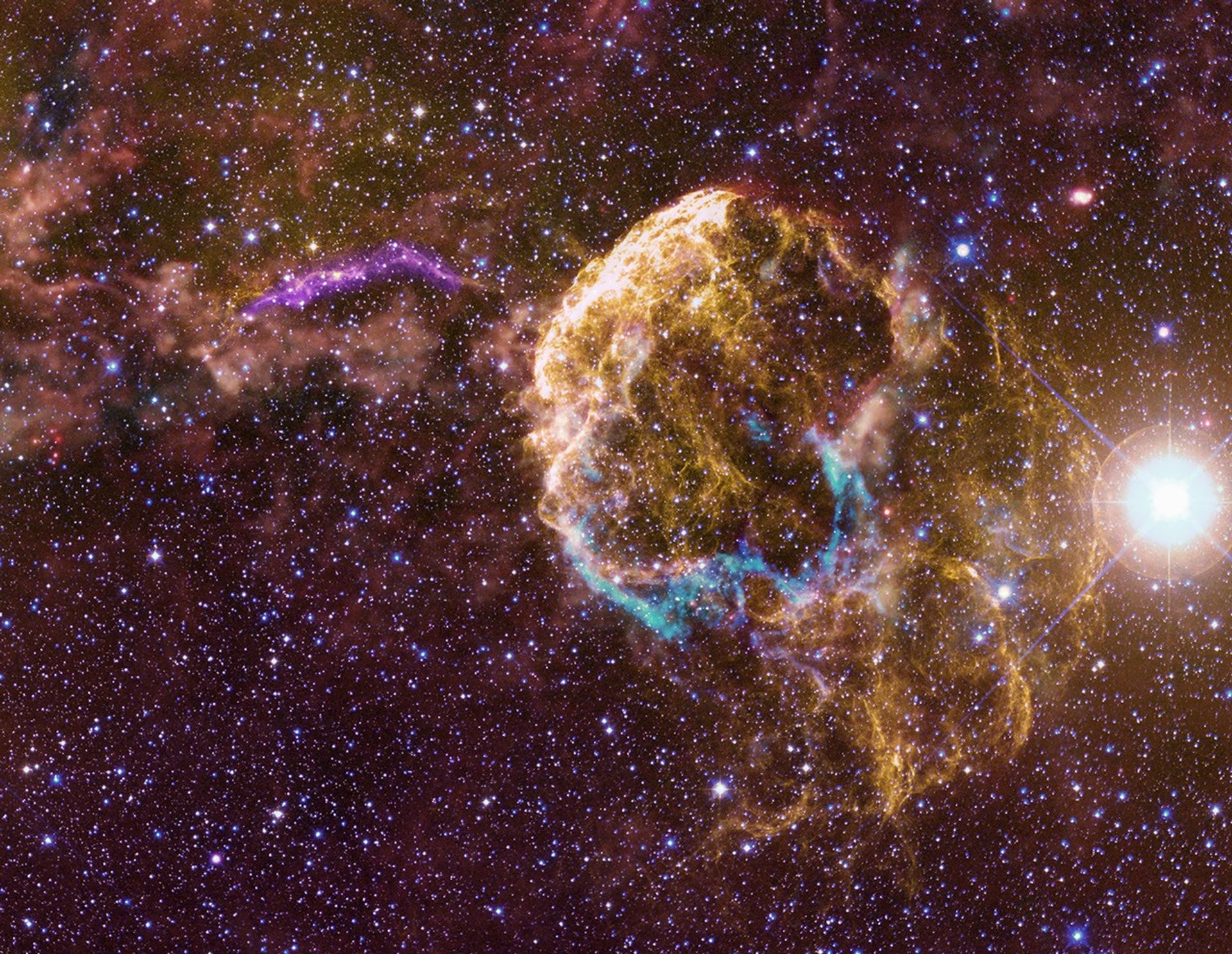
A new study of two supernova remnants, the debris left behind after stars explode, suggests the explosions came from stellar siblings that once orbited each other. The first star’s detonation sent it…
NASA — 17 June 2026
Text:
16
0
0
A new study of two supernova remnants, the debris left behind after stars explode, suggests the explosions came from stellar siblings that once orbite
Read Full Story at NASA →
⚡ Quickyla Analysis
Original editorial context — not sourced from the article above
NASA’s Fermi Mission has uncovered evidence suggesting that two distant supernova remnants may have originated from stellar siblings—pairs of stars that once orbited each other before one or both detonated in cataclysmic explosions. This discovery isn’t just a cosmic curiosity; it offers a rare glimpse into the life cycles of massive stars and the dynamic environments they inhabit. Supernova remnants, the expanding shells of gas left behind after stellar deaths, are often studied in isolation, but this finding implies a shared history between two separate explosions. Such sibling relationships, if confirmed, could reshape our understanding of how massive stars evolve and interact in binary systems, where mutual gravitational influence can dramatically alter their fates.
The broader significance lies in how these observations connect to long-standing questions about the origins of heavy elements and the role of supernovae in shaping galaxies. If these remnants indeed share a common stellar ancestry, they could provide clues about the conditions that lead to paired supernovae—events that may have occurred within mere thousands of years of each other. This timing could influence how we model galactic chemical enrichment, as nearby explosions might have seeded neighboring regions with different elemental abundances. Additionally, the Fermi Mission’s gamma-ray observations hint at high-energy processes still unfolding in these remnants, suggesting that their study could reveal lingering interactions between shockwaves and surrounding material.
Yet unresolved questions remain. Were these stars part of a once-binary system where one star’s explosion triggered its companion’s detonation, or were they simply born in the same stellar nursery, destined to die independently? The lack of direct observations of the progenitor stars complicates the picture, leaving astronomers to rely on indirect evidence like spatial alignment and chemical signatures in the debris. As next-generation telescopes come online, the ability to trace the trajectories of these remnants back in time may finally provide definitive answers.
This discovery also underscores a broader trend in astrophysics: the growing recognition that many cosmic phenomena are interconnected. From gravitational wave detections of merging black holes to the study of runaway stars ejected from supernovae, the universe increasingly appears as a web of interactions rather than isolated events. In this context, Fermi’s findings are a reminder that even the remnants of ancient explosions still hold secrets waiting to be uncovered.
Sources

🔬 Science
'Astonishing': James Webb telescope spots the most chemically primitive galaxy in the ancient universe

🔬 Science
El Niño Is Underway

🔬 Science
Astronomers gaze into the 'Crystal Ball Nebula' and see a vision of our dying sun — Space photo of the week

🔬 Science
Bacteria uncover distinct strategy to import rare sugar polymers, crystal structures show

🔬 Science
NASA Awards Contract for Johnson Space Center Infrastructure

🔬 Science
Repairing DNA damage: Scientists discover a surprising new benefit of melatonin

