🌱 Environment
Live
Q&A: What do China’s provincial five-year plans say about climate and energy?
China’s provincial-level governments have now all published their 15th five-year plans – economic and social... The post Q&A: What do China’s provincial five-year plans say about climate and energy? …
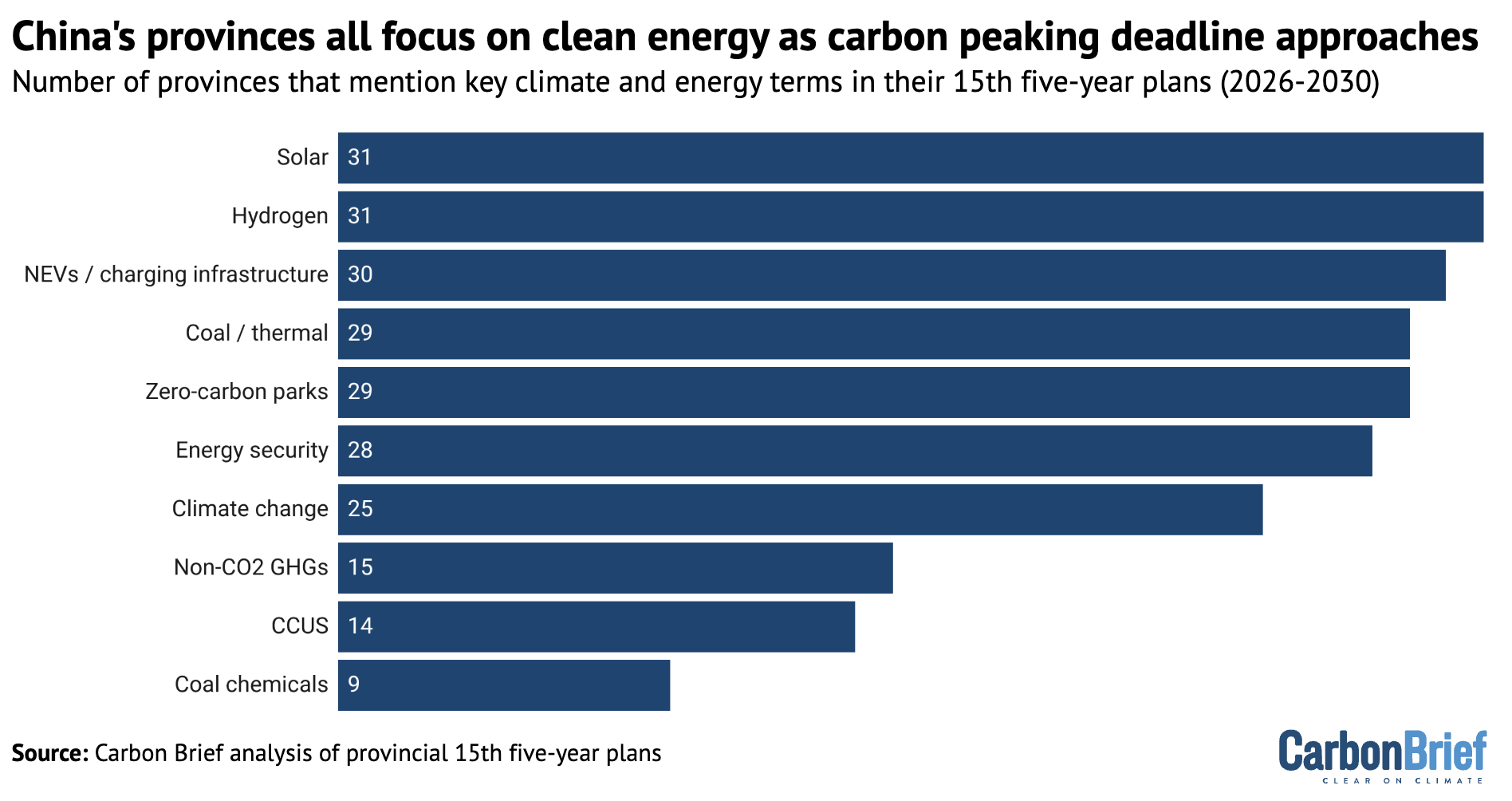
Carbon Brief — 18 June 2026
Text:
26
0
0
China’s provincial-level governments have now all published their 15th five-year plans – economic and social... The post Q&A: What do China’s provinc
Read Full Story at Carbon Brief →
⚡ Quickyla Analysis
Original editorial context — not sourced from the article above
China’s provincial five-year plans offer a revealing window into how the country’s climate and energy priorities will unfold at the local level, even as Beijing sets the broader national agenda. These documents, now finalized across all provinces, reflect a delicate balancing act: accelerating decarbonization while managing economic growth, energy security, and social stability. Their significance lies in turning abstract national targets—like peaking emissions before 2030 and achieving carbon neutrality by 2060—into tangible regional strategies, where implementation ultimately happens. The plans also reveal stark divergences in ambition, with coal-dependent regions like Inner Mongolia and Shanxi often prioritizing energy security over aggressive renewable rollouts, while coastal provinces like Guangdong and Zhejiang lean harder into green industrial policies. This patchwork approach underscores a key tension in China’s energy transition: how to reconcile local economic realities with centralized climate goals.
What many readers may overlook is the role these plans play in signaling policy direction before Beijing’s own 15th Five-Year Plan is finalized. Provincial governments, often competing for central funding and political favor, use their climate commitments as a way to court investment in renewables, hydrogen, or carbon capture—while also hedging bets by protecting legacy industries. The emphasis on "new energy" sectors, for instance, suggests a scramble to attract the next wave of manufacturing dominance, particularly in electric vehicles and batteries, where provinces like Jiangsu and Hubei are already locking in supply chains. Meanwhile, the continued prominence of coal in some plans reflects a pragmatic acknowledgment that energy security remains a non-negotiable priority, especially amid volatile global markets and grid reliability concerns.
Looking ahead, the real test will be execution. Will provinces with ambitious targets—such as Shandong’s pledge to expand offshore wind by 20 GW by 2025—deliver, or will economic pressures dilute their commitments? Another open question is how Beijing will enforce these plans, given that many lack legally binding mechanisms. The broader trend here mirrors a global pattern: even as nations commit to net-zero, subnational actors are driving the pace of change, sometimes outpacing or contradicting national policy. For observers, the next 12–18 months will be critical, as these provincial plans begin to translate into permits, investments, and grid upgrades—moments where China’s energy transition will either accelerate or stall.
Sources

🌱 Environment
Erin Brockovich criticizes Microsoft data center secrecy in Utah

🌱 Environment
Rescues in eastern Syria after the Euphrates River bursts its banks

🌱 Environment
Indonesians mark 20 years since mud volcano eruption swallowed up entire communities in East Java

🌱 Environment
Biden’s Clean Drinking Water Plan Is Being Rebranded as MAHA

🌱 Environment
Heat is Killing Wildlife Across the Animal Kingdom. A New Forecasting Tool May Help
🌱 Environment
A New N.C. Ratepayer Bill Puts the Brakes on Data Centers, but Incentivizes Fossil Fuels

