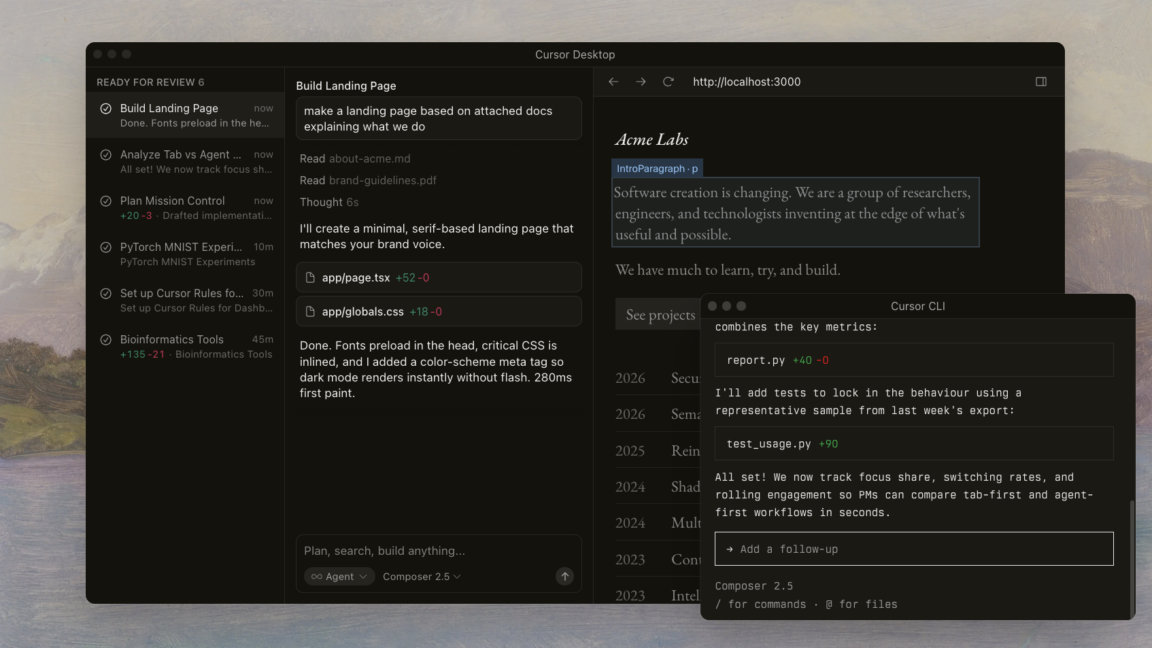
SpaceX to acquire AI coding platform Cursor for $60 billion
Separately, neither could compete. Now they hope they can.
Ars Technica — 16 June 2026
Text:
9
0
0
Separately, neither could compete. Now they hope they can. This report comes from Ars Technica. The story centres on SpaceX to acquire AI coding plat
Read Full Story at Ars Technica →
⚡ Quickyla Analysis
Original editorial context — not sourced from the article above
The proposed $60 billion acquisition of AI coding platform Cursor by SpaceX signals a bold bet on the convergence of frontier technologies, where aerospace and artificial intelligence increasingly reinforce each other. This deal isn’t just about expanding Elon Musk’s corporate empire—though that’s certainly part of it. It reflects a growing realization that automated software development may hold the key to unlocking faster innovation cycles in industries where speed and precision are existential, from satellite constellations to reusable rockets. If successful, the merger could signal a new phase where AI isn’t just a tool for engineers, but a strategic asset tightly integrated into the core infrastructure of high-tech industries.
Background context is crucial here. Cursor, though still a relative newcomer in the crowded AI coding assistant space, has gained traction among developers for its ability to auto-complete, debug, and even architect software with minimal human input. SpaceX, on the other hand, has long relied on custom-built software to manage complex systems like the Starship’s flight software and Starlink’s orbital operations. What both lacked was the scale and integration needed to push the boundaries further—Cursor in scalability, SpaceX in mission-critical deployment. By combining forces, the companies aim to create a closed-loop system where AI-generated code is tested, validated, and deployed in real-world aerospace environments, potentially reducing development timelines and human error.
Looking ahead, the deal raises several critical questions. Will regulatory scrutiny stall the acquisition, given the dual-use nature of both AI and aerospace technologies? How will SpaceX absorb and integrate Cursor’s culture and workforce, especially in a company already known for its intense, Musk-driven operational style? And perhaps most importantly, can this partnership deliver on its promise of accelerating innovation, or will it become another cautionary tale about overambitious tech megadeals?
This acquisition also fits into a broader trend: the intensifying race among tech giants to control the infrastructure that powers the next wave of industrial AI. From cloud computing to autonomous systems, companies are consolidating tools, data, and talent to dominate the ecosystems of the future. For SpaceX, the move is less about AI for its own sake, and more about securing a competitive edge in an era where software defines hardware performance. If it works, expect more such marriages of convenience between unlikely partners in the coming decade. If it stumbles, it may reveal the limits of even the most visionary corporate mergers in the age of AI.
Sources

💻 Technology
You can now beat ChatGPT Codex rate limits, if you have friends

💻 Technology
Coders are refusing to work without AI — and that could come back to bite them

💻 Technology
Cash App made a magic wand for contactless payments

💻 Technology
Hackers hijacked Instagram accounts by tricking Meta AI support chatbot into granting access

💻 Technology
Asus gives the ROX Xbox Ally the OLED screen it deserves

💻 Technology
‘Backrooms’ $118M WW Bonanza; ‘Obsession’ Obsessed With $148M WW; ‘Michael’ Nearing $900M WW – Global Box Office Update

