The world's first nuclear clock just ticked on — and it could help detect a fifth fundamental force of physics
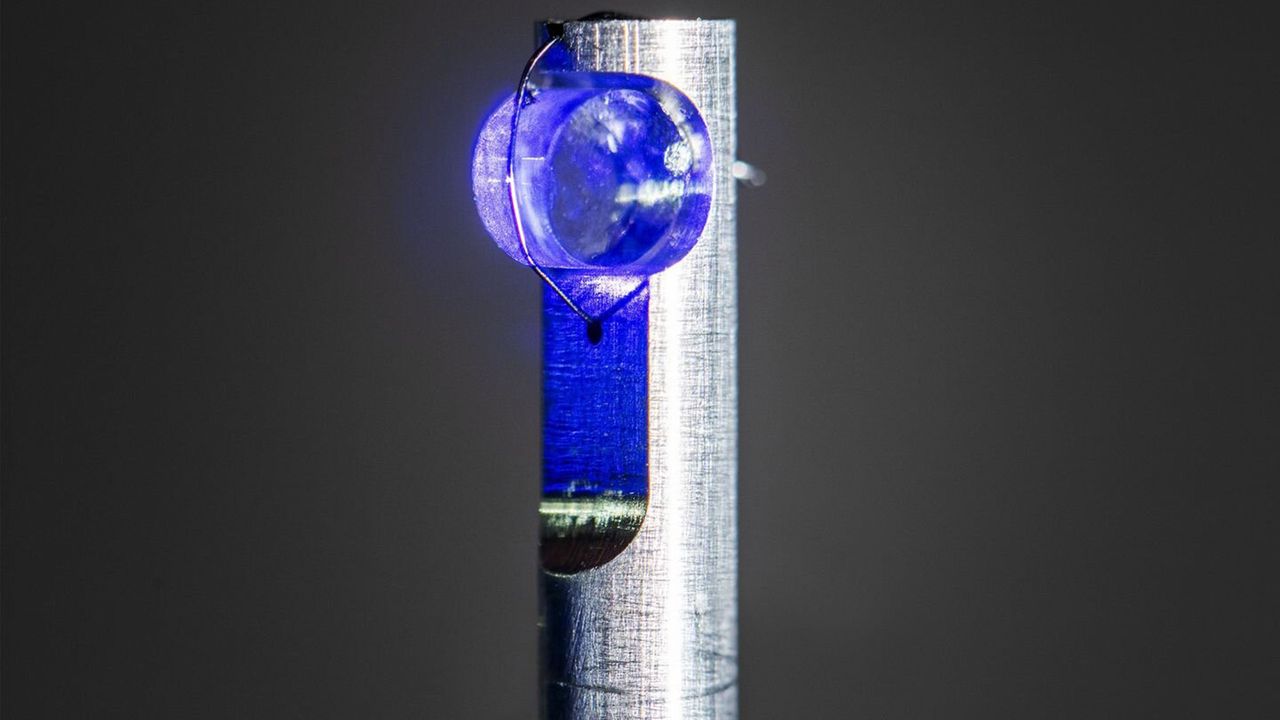
By using a rare thorium nucleus as a timekeeper, physicists have demonstrated the first working nuclear clock, a device that could lead to even more precise clocks and new ways to search for dark mat…
Live Science — 16 June 2026
Text:
19
0
0
By using a rare thorium nucleus as a timekeeper, physicists have demonstrated the first working nuclear clock, a device that could lead to even more p
Read Full Story at Live Science →
⚡ Quickyla Analysis
Original editorial context — not sourced from the article above
The debut of the world’s first nuclear clock—a device that counts time by tracking energy jumps inside a single thorium nucleus—marks more than just a technical milestone. It signals a shift in how we measure the universe itself. Traditional atomic clocks track electrons jumping between energy levels in atoms, but nuclear clocks exploit transitions deep inside the nucleus, where forces and symmetries are far less understood. Because the nucleus is a million times smaller than an atom and less susceptible to external interference, nuclear clocks promise gains in accuracy that could redefine timekeeping, navigation, and fundamental physics.
The breakthrough is rooted in decades of quiet progress. In the 1970s, physicists first proposed using thorium-229, a rare isotope with an unusually low-energy nuclear transition, as the heart of a nuclear clock. But isolating and stabilizing such transitions proved fiendishly difficult. Only now, with laser cooling, ultra-high-vacuum chambers, and finely tuned electromagnetic traps, have researchers coaxed thorium nuclei into revealing their ticking rhythm. The advance arrives at a moment when our most precise atomic clocks—already accurate to within a second over billions of years—are bumping up against limits set by quantum noise and thermal drift. Nuclear clocks could break through that barrier, potentially enabling sensors capable of detecting gravitational waves or even dark matter interactions by measuring tiny shifts in the clock’s frequency.
Yet the thorium clock also opens a door to unsettled physics. The same nuclear transition that powers the clock is sensitive to variations in fundamental constants, including the fine-structure constant that governs electromagnetic forces. If those constants drift over time or space, the nuclear clock’s ticking rate would change in ways atomic clocks cannot detect. Some theorists even speculate that the thorium transition might couple to as-yet-unknown forces, offering a new window into physics beyond the Standard Model. The next phase will test whether these clocks can spot anomalies in nuclear decay rates or reveal seasonal variations that hint at dark matter flows through Earth.
Questions remain: Can thorium clocks be made robust enough for real-world use, or will competing isotopes like uranium or plutonium prove better? Will the technology scale, or remain confined to elite labs? And crucially, will the first observed anomalies in nuclear transitions hold up under scrutiny—or dissolve into experimental noise? Whatever the answers, the nuclear clock is no longer a thought experiment. It is a live instrument, and the universe’s ticking just got louder.
Sources

🔬 Science
'Astonishing': James Webb telescope spots the most chemically primitive galaxy in the ancient universe

🔬 Science
El Niño Is Underway

🔬 Science
Astronomers gaze into the 'Crystal Ball Nebula' and see a vision of our dying sun — Space photo of the week

🔬 Science
Bacteria uncover distinct strategy to import rare sugar polymers, crystal structures show

🔬 Science
NASA Awards Contract for Johnson Space Center Infrastructure

🔬 Science
Repairing DNA damage: Scientists discover a surprising new benefit of melatonin

