🎓 Advanced GPA Calculator
Calculate, track, and predict your Grade Point Average with our comprehensive tool. Perfect for high school and college students.
GPA Calculation Type
Your Courses
GPA History
Grade Predictor
Predict your future GPA based on your target semester performance
Current GPA
Current Total Credits
Target Semester GPA
Semester Credits
Required GPA Calculator
Calculate what GPA you need this semester to reach your target cumulative GPA
Current GPA
Current Credits
Target Cumulative GPA
Semester Credits
Academic Statistics
GPA Trend Over Time
Grade Distribution
What-If Analysis
Run multiple scenarios to see how different grade outcomes would affect your GPA
Your Current Status
Current GPA
Current Credits
Test Scenarios
🎯 Why Use Our Advanced GPA Calculator?
The most comprehensive and accurate GPA calculator trusted by thousands of students across the United States. Calculate your Grade Point Average with precision and confidence.
Accurate Calculations
Our GPA calculator uses industry-standard formulas to ensure precise calculations for both weighted and unweighted GPAs. Supports all grading scales including 4.0, 5.0, and custom scales used by high schools and colleges nationwide.
Save Your Progress
Track your academic journey semester by semester. Our GPA tracker saves your calculation history, allowing you to monitor improvements, identify trends, and stay motivated throughout your academic career.
Predict Future GPA
Plan ahead with our grade predictor tool. Calculate what grades you need to achieve your target GPA, run What-If scenarios, and make informed decisions about your course selections and study priorities.
Mobile Friendly
Calculate your GPA anytime, anywhere. Our responsive design works perfectly on smartphones, tablets, and desktops. Access your GPA history and predictions on the go, whether you're in class or at home.
For All Students
Perfect for high school students, college undergraduates, and graduate students. Supports all academic levels from freshman to senior year, including AP courses, honors classes, and IB programs.
100% Free Forever
No hidden fees, no subscriptions, no premium tiers. Access all features completely free including GPA calculations, predictions, statistics, data export, and unlimited history tracking. Always free, forever.
📚 How to Calculate Your GPA - Complete Guide
Understanding how Grade Point Average is calculated is essential for academic success. Follow our step-by-step guide to master GPA calculations.
1 List All Your Courses
Start by listing every course you're taking this semester. Include the course name (e.g., "Calculus I", "English Composition", "Biology 101") to keep your records organized. This helps you track each class individually and makes it easier to identify areas for improvement.
2 Enter Letter Grades
Input the letter grade you received (or expect to receive) for each course. Common grades include A (excellent), B (above average), C (average), D (below average), and F (failing). Many schools also use plus (+) and minus (-) modifiers to provide more granular assessment.
- A (90-100%) = 4.0 points
- B (80-89%) = 3.0 points
- C (70-79%) = 2.0 points
- D (60-69%) = 1.0 points
- F (below 60%) = 0.0 points
3 Add Credit Hours
Enter the number of credit hours (also called credit units or semester hours) for each course. Most college courses are 3-4 credits, but this can vary. Lab courses might be 1-2 credits, while intensive courses could be 5-6 credits. Check your course registration or syllabus for accurate credit hour information.
4 Select Course Type (If Weighted)
For high school students or schools using weighted GPAs, specify whether each course is Regular, Honors, or AP/IB. Weighted GPAs give bonus points for advanced courses: Honors classes typically add 0.5 points, while AP and IB courses add 1.0 point to your base grade. This rewards students for taking more challenging coursework.
5 Calculate Your GPA
Click the "Calculate GPA" button and instantly see your results. The calculator multiplies each grade point value by its credit hours to get quality points, sums all quality points, then divides by total credit hours. The formula is: GPA = (Sum of Quality Points) ÷ (Total Credit Hours). Your result appears with detailed breakdowns, grade quality assessment, and insights.
- 4.0 - 3.7: Excellent (A range) - Dean's List, Honors
- 3.6 - 3.3: Very Good (A-/B+ range) - Above Average
- 3.2 - 3.0: Good (B range) - Satisfactory Progress
- 2.9 - 2.7: Above Average (B-/C+ range)
- 2.6 - 2.0: Average (C range) - Passing
- Below 2.0: Below Average - May need academic support
⚖️ Weighted vs Unweighted GPA - Which Should You Use?
Understanding the difference between weighted and unweighted GPA is crucial for accurate academic assessment and college applications.
📘 Unweighted GPA (4.0 Scale)
The traditional and most commonly used GPA scale. All courses are treated equally regardless of difficulty level. Maximum achievable GPA is 4.0.
✅ When to Use:
- Standard college GPA calculations
- Most scholarship applications
- Graduate school admissions
- Comparing students fairly
- NCAA athletic eligibility
📊 Grade Scale:
- A = 4.0 points
- B = 3.0 points
- C = 2.0 points
- D = 1.0 points
- F = 0.0 points
📗 Weighted GPA (5.0+ Scale)
Rewards students for taking advanced courses by adding bonus points. Honors classes get +0.5, AP/IB courses get +1.0. Maximum can exceed 5.0.
✅ When to Use:
- High school GPA calculations
- Competitive college admissions
- Class rank determination
- Valedictorian/Salutatorian selection
- Honors program applications
📊 Grade Scale Example (AP Course):
- A = 5.0 points (+1.0 bonus)
- B = 4.0 points (+1.0 bonus)
- C = 3.0 points (+1.0 bonus)
- D = 2.0 points (+1.0 bonus)
- F = 0.0 points (no bonus)
💡 Important Note for College Applications
Most colleges recalculate your GPA using their own scale, so submit both weighted and unweighted GPAs when possible. Admissions officers consider course rigor (AP/IB classes) separately, so taking challenging courses benefits you regardless of the GPA scale used. Many top universities look at unweighted GPA (4.0 scale) but also consider the difficulty of your course load when making admissions decisions.
🏛️ GPA Requirements by College Tier
Understanding GPA benchmarks for different college tiers helps you set realistic goals and target appropriate schools. Here's what you need to know for college admissions in 2026.
🌟 Elite/Ivy League Universities (Top 20)
Schools: Harvard, Yale, Princeton, Stanford, MIT, Columbia, UPenn, Brown, Dartmouth, Cornell, Duke, Northwestern, Johns Hopkins
Reality Check: These schools expect near-perfect GPAs PLUS rigorous course loads (10+ AP classes), exceptional test scores, unique extracurriculars, and compelling essays. A 4.0 alone doesn't guarantee admission - holistic review considers your entire application.
🎓 Highly Selective Universities (Top 50)
Schools: UCLA, UC Berkeley, University of Michigan, UNC Chapel Hill, NYU, Boston College, Vanderbilt, Rice, Emory, Georgetown
What You Need: Strong GPA with challenging courses (5-8 AP/IB classes), solid test scores (if required), demonstrated leadership, and genuine passion in extracurriculars. Geographic diversity and unique perspectives can help.
📚 Selective Universities (Top 100)
Schools: University of Florida, Penn State, University of Texas, University of Wisconsin, Ohio State, Georgia Tech, University of Washington
What You Need: Solid academic record with some advanced courses, good test scores, meaningful extracurriculars, and strong essays. These schools offer excellent education with slightly higher acceptance rates.
🏫 Moderately Selective Universities
What You Need: Consistent B average or better, reasonable course load, participation in activities, and solid character. These schools offer quality education with good acceptance rates and excellent value. Perfect for students who want a strong college experience without extreme competitiveness.
📈 10 Proven Strategies to Improve Your GPA
Whether you're trying to raise your GPA for college admissions, scholarships, or personal achievement, these evidence-based strategies actually work.
1. Time Management Mastery
Use a planner or digital calendar to track all assignments, tests, and deadlines. Break large projects into smaller tasks. The Pomodoro Technique (25 minutes focused work, 5 minute break) increases productivity. Prioritize high-credit courses for maximum GPA impact.
2. Form Study Groups
Collaborate with serious students who challenge you. Teaching concepts to others reinforces your own understanding. Study groups catch mistakes you might miss alone and provide motivation. Meet regularly, stay focused, and rotate who leads each session.
3. Utilize Office Hours
Professors and TAs want to help you succeed. Office hours provide one-on-one clarification, exam insights, and relationship building. Go prepared with specific questions. Building rapport with instructors can lead to better letters of recommendation and academic opportunities.
4. Active Note-Taking
Don't just transcribe lectures - engage with the material. Use Cornell Method, mind maps, or color coding. Review and refine notes within 24 hours while fresh. Writing things down improves retention by 50% compared to passive listening.
5. Focus on High-Impact Courses
Prioritize 3-4 credit courses over 1-credit courses for maximum GPA improvement. One grade change in a 4-credit class impacts your GPA 4x more than in a 1-credit class. Use our calculator to identify which courses matter most.
6. Get Tutoring Early
Don't wait until you're failing to seek help. Most schools offer free tutoring centers. Start in week 2-3 of the semester. Consistent tutoring prevents knowledge gaps from compounding. Even A students use tutors to maintain excellence and learn efficient techniques.
7. Read Ahead
Preview next week's material before class. Even skimming creates mental hooks for lectures. You'll understand faster, participate better, and ask smarter questions. This transforms you from passive listener to active learner, significantly improving comprehension and grades.
8. Prioritize Sleep
Students who sleep 7-8 hours score 10% higher than those who sleep 6 or less. Sleep consolidates learning and improves memory retention. All-nighters decrease performance. Better to get adequate sleep before exams than cram until 3 AM.
9. Never Miss Easy Points
Attend every class (participation points), complete all homework (even if only worth 10%), do extra credit when offered. These "easy points" add up. Students who maximize participation and homework often end up with higher grades than those who ace tests but skip assignments.
10. Track Your Progress
Use our GPA calculator weekly to monitor your standing. Set specific GPA goals each semester. Seeing progress (or decline) early allows course correction. Calculate what grades you need on finals using our prediction tools. Data-driven students perform better.
🎯 Pro Tip: The Compound Effect
Small, consistent improvements compound over time. Raising your GPA by just 0.1 points each semester for 4 semesters results in a 0.4 point increase. That's the difference between a 3.2 and a 3.6 - potentially thousands in scholarship money and access to competitive programs. Start today, stay consistent, and use our calculator to track your journey!
🚀 Start Calculating Your GPA Now!
Join thousands of students who use our advanced GPA calculator to track their academic progress, predict future outcomes, and achieve their educational goals. It's completely free, works on any device, and requires no signup.
About Our GPA Calculator
AZRS Corp's Advanced GPA Calculator is the most comprehensive and accurate tool for calculating Grade Point Average. Trusted by students nationwide since 2024, we provide free, instant GPA calculations with advanced features like predictions, What-If scenarios, and detailed analytics.
Popular Searches
- • College GPA Calculator
- • High School GPA Calculator
- • Weighted GPA Calculator
- • Cumulative GPA Calculator
- • GPA to Letter Grade
- • How to Raise My GPA
Student Resources
- 📖 How to Calculate GPA
- 📊 GPA Scale Guide
- 🎯 Study Tips
- 💡 Academic Planning
- 🏆 Scholarship Requirements
- 📈 GPA Improvement Tips
© 2024- AZRS Corp. All rights reserved. | Free GPA Calculator for Students Worldwide
Keywords: GPA Calculator, College GPA, High School GPA, Weighted GPA, Unweighted GPA, Cumulative GPA, Grade Point Average, Academic Calculator, Grade Predictor, Transcript Calculator, GPA Tracker, Free Online GPA Calculator 2026
See Free Advanced GPA Calculator in action
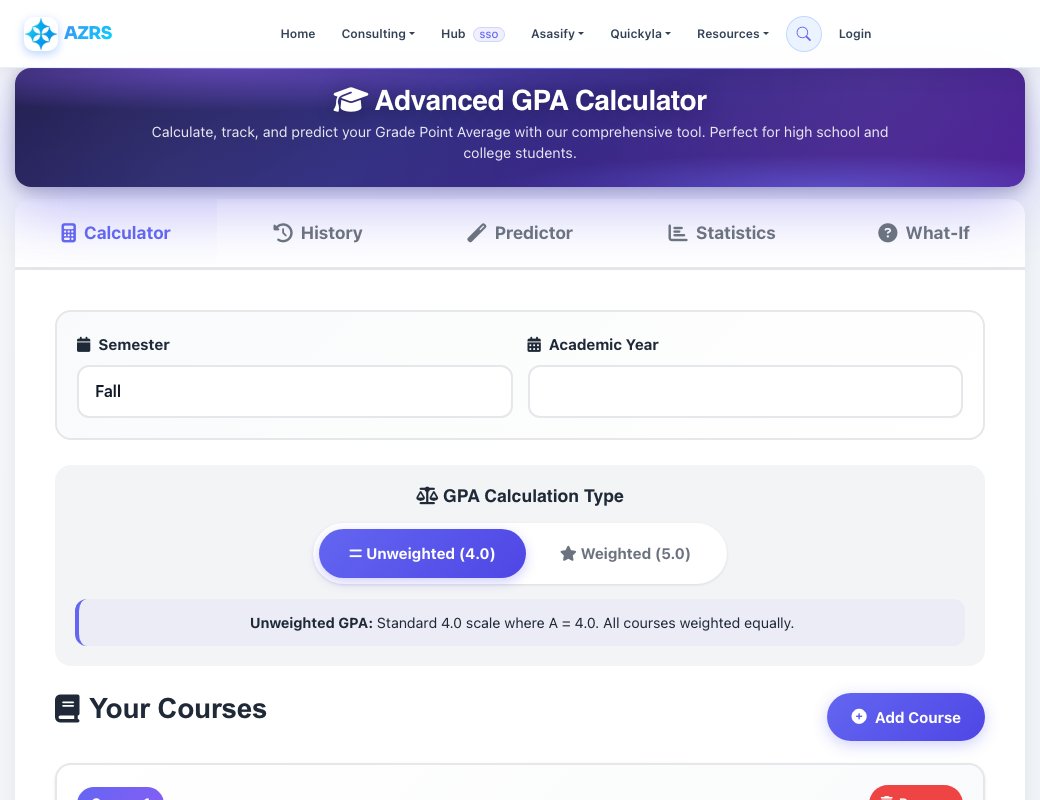
Free Advanced GPA Calculator
Calculate your Grade Point Average from individual course grades and credit hours. Add each course with its letter grade (or numeric score) and credit hours, and the calculator computes your weighted GPA instantly using the standard 4.0 scale, along with tools for tracking and predicting grades.
Because credit hours are weighted correctly, a 4-credit A counts more toward your GPA than a 1-credit A — this calculator handles that weighting automatically so you don't need to do it by hand.
Key features
Weighted GPA by credit hours
Correctly weights each course by its credit value, not a simple average.
Letter grade and numeric support
Enter grades as letters (A, B+, etc) or as numeric scores.
Add unlimited courses
Build a full semester or full transcript's worth of courses.
Save and track over time
Log in to save calculations and build a GPA history across semesters.
How to use it
- Add a course with its name (optional), letter grade and credit hours.
- Repeat for every course in the semester.
- Review your calculated GPA instantly as you add courses.
- Save the calculation to your account to track it over time.
Worked example
Example
Three courses — an A (4.0) in a 4-credit class, a B+ (3.3) in a 3-credit class, and a B (3.0) in a 3-credit class — give a weighted GPA of (4.0×4 + 3.3×3 + 3.0×3) ÷ 10 = 3.49.
Who uses this tool
College and university students
Calculate a semester or cumulative GPA quickly and accurately.
High school students
Track GPA toward college applications.
Academic advisors
Quickly verify a student's GPA calculation.
Tips for the best results
- Always weight by credit hours, not a simple average of letter grades — a 1-credit and a 4-credit A are not worth the same to your overall GPA.
- Check whether your school uses a 4.0, 4.3 or a different scale, since letter-to-point mappings vary slightly between institutions.
- Save your calculations if you're logged in so you can track your GPA trend across multiple semesters in one place.
- Recalculate your cumulative GPA (not just the current semester) when checking eligibility for scholarships or honors.
Common mistakes to avoid
- Averaging letter grades without weighting by credit hours, which gives an inaccurate GPA.
- Using the wrong grade scale for your specific school (some use 4.3 for A+, others cap at 4.0).
- Forgetting to include a course with a low grade, which skews the calculated GPA upward inaccurately.
Why use AZRS QuickFix?
It is 100% free, needs no signup and has no watermark or usage limits. The tool runs in your browser, so what you type stays on your device, and it works on phones, tablets and desktops. New tools are added every week — bookmark this page or browse the full QuickFix toolbox.
Frequently asked questions
How is GPA calculated?
Each course's grade points (based on the school's scale) are multiplied by its credit hours, summed across all courses, then divided by the total credit hours.
What's the difference between semester and cumulative GPA?
Semester GPA covers just the current term's courses; cumulative GPA weights every course you've ever taken across all terms.
Is this GPA calculator free?
Yes, free with no signup required to calculate; logging in only adds saving and history features.
Does it support A+ grades above 4.0?
It supports the standard 4.0 scale used by most US institutions; check your school's specific scale if it differs.
Can I save my GPA history?
Yes, log in to save calculations and track your GPA across semesters.
Is my grade data private?
Yes, grade data is tied only to your own account and not shared.